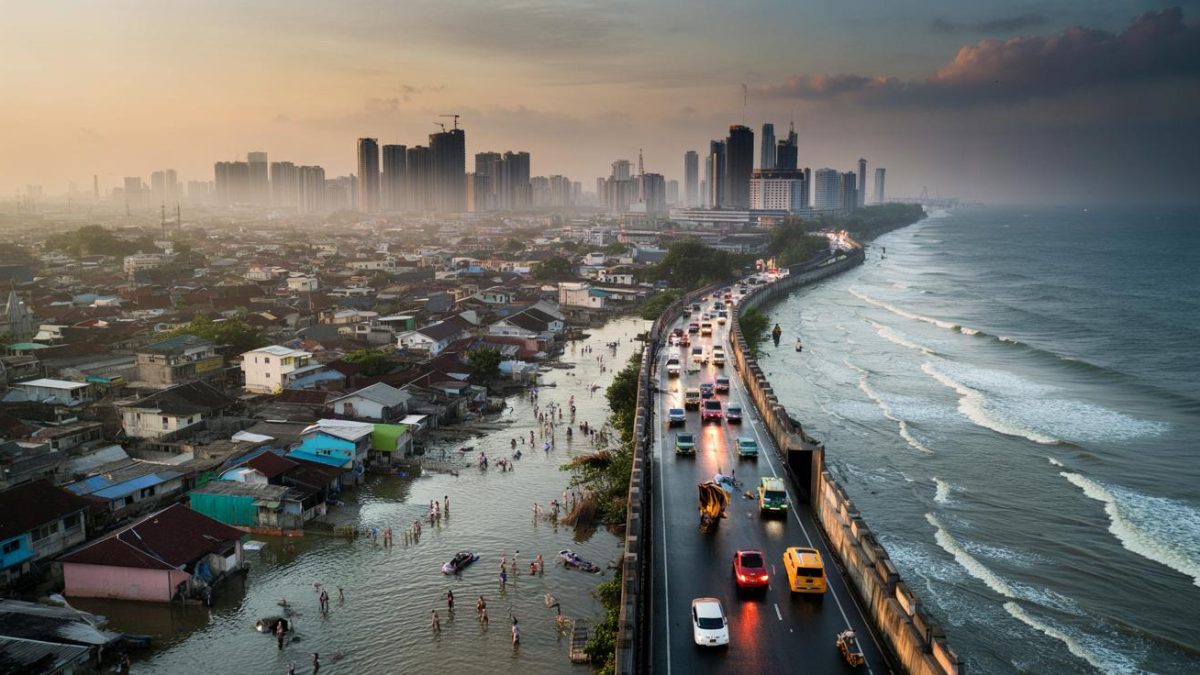
Jakarta, the bustling capital of Indonesia, is facing a daunting challenge – its very foundations are sinking, and the city is slowly but steadily disappearing into the sea. As the world’s largest metropolitan area, with a population of over 30 million, this megacity’s plight serves as a stark warning for urban centers across the globe.
Beneath the towering skyscrapers, congested streets, and the hustle and bustle of daily life, a hidden crisis is unfolding. The land beneath Jakarta is slowly but surely giving way, a result of a complex interplay between human activities, environmental factors, and the relentless march of climate change.
Sinking Foundations: The Alarming Decline of Jakarta
Jakarta’s woes stem from a combination of factors, chief among them the city’s rapid and uncontrolled development. As the population has swelled, the demand for housing, infrastructure, and resources has skyrocketed, leading to the construction of countless high-rises, roads, and industrial facilities.
However, this breakneck pace of development has come at a steep price. The city’s groundwater reserves have been depleted at an alarming rate, as residents and businesses alike tap into this precious resource to meet their needs. This, in turn, has caused the land to subside, with some areas sinking by as much as 25 centimeters per year.
- ➡Der Schlüssel zu kräftigeren und gesünderen Tomaten: Ein einfacher Trick für den Garten
- ➡Das Ende der vermasselten Rosenpflege: Die einfache Schnitttechnik vom Profi
- ➡Diese Zimmerpflanze kann Ihre Wohnung von schlechter Energie und Gerüchen reinigen
- ➡Wie Fische 2026 eine wichtige Chance verpassen, weil sie sich nicht trauen zu handeln
Adding to the problem is the city’s location, which is largely built on swampy, low-lying land near the Java Sea. As the sea levels rise due to climate change, the already fragile foundations of Jakarta are being further compromised, accelerating the city’s descent into the waters.
A Ticking Time Bomb: The Threat of Flooding
The sinking of Jakarta poses a grave threat to the city’s infrastructure and the well-being of its residents. As the land continues to subside, the risk of catastrophic flooding increases exponentially. During the rainy season, the streets of Jakarta are already prone to severe inundation, with many neighborhoods becoming virtual islands.
However, the true danger lies in the potential for a major flood event, which could devastate the city’s fragile systems. Experts warn that if the current trends continue, as much as 95% of the city could be submerged by 2050, leaving millions of people displaced and the economy in ruins.
The impact of such a disaster would be far-reaching, affecting not only the residents of Jakarta but also the entire country of Indonesia and the broader region. The loss of this economic and cultural hub would be a catastrophic blow, with ripple effects that could be felt for decades to come.
- ➡Goodbye Showers: Japan’s “Human Washing Machine” Replaces the Shower Cubicle
- ➡Eine Glasschale mit Rosmarin und Salz: Natürlicher Raumduft ohne chemische Sprays und Duftkerzen
- ➡Nie wieder Mittagstief: Mit diesem 10-Minuten-Trick bleibst du wach und konzentriert
- ➡Hund oder Katze: Diese Dokumente dürfen Sie niemals verlieren
The Race Against Time: Efforts to Save Jakarta
Faced with this daunting challenge, the Indonesian government and local authorities have taken steps to address the crisis, though the solutions are far from simple. One of the most ambitious efforts is the construction of a massive sea wall, known as the “Giant Sea Wall,” which is designed to protect the city from rising sea levels and prevent further subsidence.
However, the project has faced numerous challenges, including funding shortages, construction delays, and concerns about its long-term effectiveness. Additionally, some experts argue that the sea wall is a band-aid solution, and that more comprehensive measures are needed to address the underlying causes of Jakarta’s sinking.
Other initiatives, such as efforts to restrict groundwater extraction, promote sustainable urban development, and improve the city’s drainage and flood management systems, have also been implemented. But the scale of the problem is daunting, and many believe that the race against time is already being lost.
A Global Lesson: Lessons from Jakarta’s Plight
The fate of Jakarta serves as a sobering reminder of the urgent need for cities around the world to rethink their approach to urban development and environmental sustainability. As the effects of climate change become increasingly pronounced, the vulnerabilities of megacities like Jakarta will only become more pronounced.
- ➡Schluss mit Kräutertee: Dieser Ingwer-Trick stoppt Blähbauch nach dem Essen
- ➡Wird Starfleet Academy auf Paramount+ nach Staffel 2 fortgesetzt?
- ➡Nachbarn eilen streunender Hündin in den Wald zu Hilfe – Die rührende Entdeckung, die sie dort machen
- ➡Erlebnis der totalen Sonnenfinsternis 2026 in Spanien: Die besten Beobachtungsorte für Urlauber
Experts believe that the lessons learned from Jakarta’s struggle can be applied to other rapidly growing urban centers, particularly those located in low-lying, coastal regions. By prioritizing sustainable urban planning, investing in resilient infrastructure, and addressing the root causes of environmental degradation, cities can better prepare for the challenges of the future.
Ultimately, the fate of Jakarta will have far-reaching implications, not just for Indonesia but for the global community as a whole. As the world’s population becomes increasingly urbanized, the need to find innovative solutions to the challenges facing megacities has never been more pressing. The future of our cities, and perhaps the planet itself, may very well hinge on our ability to learn from the cautionary tale of Jakarta.
Confronting the Harsh Realities: Experts Weigh In
“Jakarta’s sinking is a complex issue, a convergence of human-induced factors and the relentless forces of climate change. We’re witnessing a perfect storm that threatens to submerge one of the world’s largest cities, with catastrophic consequences for the region and the global community.” – Dr. Aditya Bayu, urban planning specialist
“The race to save Jakarta is a race against time, and the odds are stacked against us. The city’s foundations are crumbling, and the solutions being implemented are simply not enough to keep pace with the rate of subsidence and rising sea levels. We need a complete rethinking of how we approach urban development in the face of these immense challenges.” – Amelia Susanti, environmental policy expert
“Jakarta’s plight is a wake-up call for the global community. This is not just a local issue, but a harbinger of the challenges that many other coastal cities will face in the coming decades. We must learn from Jakarta’s experience and take immediate action to build more resilient, sustainable cities that can withstand the impacts of climate change.” – Professor Indra Kumala, climate change researcher
Tackling the Sinking City: Potential Solutions
| Solution | Description | Potential Impact |
|---|---|---|
| Groundwater Management | Strict regulations on groundwater extraction, coupled with the promotion of alternative water sources, such as desalination and rainwater harvesting. | Reducing the rate of land subsidence and preserving the city’s foundations. |
| Sustainable Urban Planning | Comprehensive urban planning that prioritizes green spaces, efficient transportation, and resilient infrastructure, with a focus on flood mitigation and disaster preparedness. | Enhancing the city’s overall resilience and reducing the risk of catastrophic flooding. |
| Relocation and Adaptation | Gradual relocation of vulnerable populations and critical infrastructure to higher ground, combined with the adaptation of existing buildings and systems to withstand the effects of sinking and flooding. | Protecting lives and assets while mitigating the long-term impacts of the city’s decline. |
A Cautionary Tale: The Fate of Jakarta and Beyond
The plight of Jakarta serves as a stark reminder of the urgent need for cities worldwide to confront the challenges posed by climate change, environmental degradation, and unsustainable development. As the world’s population becomes increasingly urbanized, the fate of megacities like Jakarta will have far-reaching implications for the global community.
By learning from Jakarta’s experience and implementing comprehensive, forward-thinking solutions, other cities can work to prevent a similar fate and build more resilient, sustainable urban centers. The future of our cities, and perhaps the very future of our planet, may very well hinge on our ability to heed the lessons of Jakarta’s sinking.
- ➡Kia EV3 im ersten Test: Was der kleine Elektro-SUV wirklich kann
- ➡Dieser einfache Backpulver-Trick macht Ihre Sportschuhe wieder frisch riechen
- ➡TV-Star setzt auf Trend: Diese weißen Nike-Sneaker will jetzt jeder
- ➡50 Jahre abgelaufener Lachs: Was Forscher in der Dose fanden, lässt Meeresbiologen staunen
FAQs
What is the primary cause of Jakarta’s sinking?
The primary cause of Jakarta’s sinking is the rapid and uncontrolled extraction of groundwater, which has led to widespread land subsidence throughout the city.
How fast is Jakarta sinking?
In some areas, Jakarta is sinking by as much as 25 centimeters per year, with experts warning that up to 95% of the city could be submerged by 2050 if current trends continue.
What are the main consequences of Jakarta’s sinking?
The main consequences of Jakarta’s sinking include an increased risk of catastrophic flooding, damage to critical infrastructure, the displacement of millions of residents, and the potential collapse of the city’s economy.
What is the “Giant Sea Wall” project, and will it save Jakarta?
The “Giant Sea Wall” is a massive infrastructure project designed to protect Jakarta from rising sea levels and prevent further subsidence. However, the project has faced numerous challenges, and many experts believe it is not a long-term solution to the city’s problems.
What can other cities learn from Jakarta’s experience?
Other cities can learn the importance of sustainable urban planning, effective groundwater management, and building resilience to the impacts of climate change, in order to avoid a fate similar to that of Jakarta.
Is it too late to save Jakarta?
While the situation in Jakarta is dire, experts believe that it is not too late to implement comprehensive solutions that could mitigate the city’s decline. However, time is running out, and decisive action must be taken in the near future.
What are the potential long-term impacts of Jakarta’s sinking on the region and the world?
The loss of Jakarta as a major economic and cultural hub would have far-reaching consequences, affecting the entire country of Indonesia and the broader Southeast Asian region. The global community would also feel the impact, as Jakarta’s decline would disrupt trade, commerce, and the flow of people and resources.
What are the main challenges in implementing solutions to save Jakarta?
The main challenges include securing sufficient funding, overcoming bureaucratic and political obstacles, coordinating the efforts of various stakeholders, and addressing the complex underlying issues that have led to Jakarta’s sinking in the first place.
- ➡Warum frühes Jäten von Unkraut zwischen Pflastersteinen alles nur schlimmer macht
- ➡Abnehmen ohne Quälerei: Dieser kleine Teller-Trick schlägt stundenlanges Training
- ➡Diabetes-Pille könnte Senioren vor Erblindung durch Makuladegeneration schützen
- ➡7 seltene Charakterzüge von Menschen, die heimlich Müll aufheben