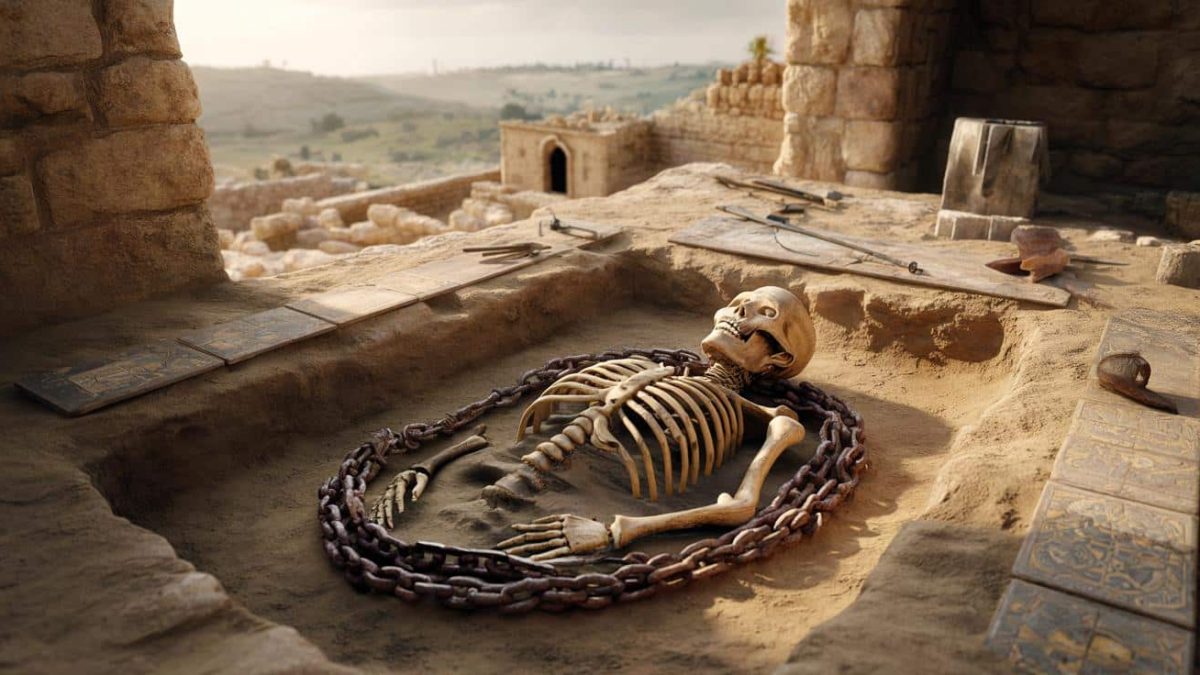
In the ruins of a 5th-century Byzantine monastery near Jerusalem, archaeologists have made a discovery that has experts around the world sitting up and taking notice. The unearthing of a chained skeleton has shed new light on the hidden lives of women in the Byzantine Christian tradition.
For centuries, the focus of monastic history has been primarily on the ascetic lives of male monks. But this recent excavation challenges that narrative, offering a glimpse into the rarely documented experiences of female monastics in the Byzantine era.
A Monastery near Jerusalem and a Chained Skeleton
The archaeological site lies just outside the ancient walls of Jerusalem, where the remains of a well-preserved Byzantine monastery from the 5th century AD have been uncovered. It was among these ruins that the team of experts stumbled upon a startling discovery – the skeletal remains of a woman, her wrists still bound in chains.
The find immediately sparked intense interest, not only for its macabre nature but also for the implications it holds about the lives of women in Byzantine monastic communities. Archaeologists and historians are now racing to uncover the full story behind this chilling relic.
- ➡Floating Turbines in the Rhine: How “Energy Fish” Are Meant to Fill Power Gaps
- ➡Dieses leckere Wintergericht bereite ich immer voraus – abends bleibt nur noch Genuss übrig
- ➡Das Urgetreide, das Ihr Porridge auf ein neues Level bringt
- ➡Warum ich Labello & Co. durch diesen Nachtbalsam für die Lippen ersetze
Sophisticated laboratory analysis of the skeleton and the site itself has already begun to reveal a complex and previously untold narrative.
High-Tech from the Lab: A Single Tooth Crown Solves the Mystery
One of the keys to unraveling the mystery lies in the careful examination of the skeleton’s dental remains. Using advanced protein analysis techniques, researchers were able to extract information about the individual’s diet and origin that would have been impossible to glean from the bones alone.
The analysis revealed that the woman had a diet consistent with a monastic lifestyle, rich in grains and low in animal proteins. Furthermore, the chemical signatures in her teeth pointed to her having spent the majority of her life in the region surrounding Jerusalem.
These findings, combined with the tell-tale chains, paint a chilling picture of a woman who was likely a cloistered nun in the Byzantine monastery, perhaps punished or imprisoned for some unknown transgression.
- ➡Endometriose in Thüringen: Warum immer mehr Frauen endlich eine Diagnose bekommen
- ➡Dürfen Lebensmittel kurz vor Ablauf eingefroren werden? Eine Virologin klärt auf
- ➡Spinnenblume im Frühling: Diese 6 Pflegetipps bringen einen üppigen Blätterschmuck
- ➡Heizungsfehler im Frühling: Warum das komplette Abschalten teuer werden kann
Asceticism in Christianity: A Focus on Male Monks
The discovery of this female skeleton in chains challenges the common historical narrative, which has tended to focus almost exclusively on the ascetic lives of male monastics in the Byzantine era.
While the self-denial and devotion of male monks have been well-documented, the experiences of women in these religious communities have often been obscured or overlooked. This excavation offers a rare glimpse into the harsh realities that some Byzantine nuns may have faced.
Scholars are now eager to uncover more about the role and treatment of women in these monastic settings, shedding light on a long-neglected aspect of Byzantine religious history.
New Questions about Old Finds
The discovery of the chained female skeleton has not only raised new questions about the lives of Byzantine nuns but has also prompted a re-evaluation of previous archaeological finds in the region.
- ➡Das geheimnisvolle Naturdünger-Geheimnis für saftvolle Tomaten: Wie “Bisongold” Chemie ersetzt
- ➡Wie ein römischer Kaiser vor 1.800 Jahren unsere Bürgerrechte prägte
- ➡Die neue Cholesterin-Pille verspricht einen kräftigen Rückgang des LDL-Cholesterins ohne Injektion
- ➡Diese Altstadt in Osteuropa übertrifft sogar Neapel: Europas kompakteste historische Schatzkammer
Experts are now combing through old records and re-examining existing evidence, searching for clues that might reveal similar stories of women in Byzantine monasteries. This renewed focus could lead to a significant shift in our understanding of the era’s religious and social dynamics.
As the investigation continues, archaeologists and historians alike are hopeful that this remarkable find will open up new avenues of research and shed light on a long-neglected aspect of Byzantine history.
What Asceticism Meant in Byzantine Daily Life
The chained skeleton found in the Byzantine monastery near Jerusalem serves as a stark reminder of the harsh realities of ascetic life in the Byzantine era. While the self-denial and devotion of male monastics have been well-documented, this discovery offers a rare glimpse into the experiences of women who chose or were forced into such a rigorous religious lifestyle.
The analysis of the woman’s diet and origins suggests that she likely spent her entire life within the confines of the monastery, denying herself the comforts and freedoms of the outside world. The chains found around her wrists indicate that she may have been further punished or imprisoned for some unknown transgression against the monastic rules.
This grim discovery challenges the traditional narrative and forces us to confront the often-overlooked experiences of Byzantine nuns. As researchers delve deeper into the site and re-examine existing evidence, we can expect to gain a more comprehensive understanding of what asceticism truly meant for women in the Byzantine Christian tradition.
How Protein Analysis is Transforming Archaeology
The groundbreaking work done by researchers on the chained female skeleton found in the Byzantine monastery near Jerusalem highlights the transformative power of modern laboratory techniques in the field of archaeology.
By employing advanced protein analysis methods, the team was able to extract a wealth of information from the skeleton that would have been impossible to obtain through traditional archaeological methods alone. From the woman’s dietary habits to her likely origins, these sophisticated analyses have provided vital clues that have helped to piece together her story.
As this case demonstrates, the integration of high-tech laboratory work with traditional archaeological fieldwork is opening up new avenues of research and shedding light on long-forgotten aspects of the past. Experts are hopeful that continued advances in fields like proteomics and stable isotope analysis will continue to revolutionize the way we understand and interpret archaeological finds.
- ➡Luc Alphand und seine Patchwork-Familie: Warum seine Kinder verschiedene Pässe haben
- ➡Gigantic Mall Near Paris Lies Deserted: How a Shopping Dream Became a Ghost Town
- ➡Der neue Garnier-Beauty-Trend: Getöntes Fluid mit LSF50 zaubert einen Filter-Teint
- ➡Toilet paper is yesterday’s news: Why more and more people are switching to water
What Everyday People Can Take Away from This Find
The discovery of the chained female skeleton in the Byzantine monastery near Jerusalem is not just a significant archaeological find, but also a poignant reminder of the often-hidden experiences of women throughout history.
While the lives of male monastics have been extensively documented, the stories of women in these religious communities have long been overlooked or obscured. This excavation offers a rare glimpse into the harsh realities that some Byzantine nuns may have faced, challenging the traditional narrative and sparking new questions about the role of women in the Christian tradition.
For everyday people, this discovery serves as a powerful reminder of the importance of uncovering and preserving the diverse experiences and perspectives that make up our shared history. By shedding light on the untold stories of the past, we can gain a deeper understanding of the complexities and inequalities that have shaped the human experience over the centuries.
| Key Facts | Details |
|---|---|
| Location | Ruins of a 5th-century Byzantine monastery near Jerusalem |
| Discovery | Skeletal remains of a woman, with her wrists still bound in chains |
| Analysis | Sophisticated protein analysis revealed the woman’s diet and origin, consistent with a monastic lifestyle |
| Significance | Challenges the traditional focus on male monastics, offering a rare glimpse into the experiences of Byzantine nuns |
- ➡Neue Super-Solarzellen und Fusion-Durchbruch: Warum 2026 zum Energie-Wendepunkt wird
- ➡Forscher entdecken: Gefährliche Bullenhaie haben ein heimliches Sozialleben
- ➡From Impulse to Paradise: How a Brit Turned His Own Mini-Island into a National Park
- ➡Wie Sie Bananen tagelang gelb halten können: Einfache Tricks, die wirklich funktionieren
“This discovery is a game-changer in our understanding of women’s roles and experiences in Byzantine monasticism. It forces us to re-evaluate the historical narratives that have long dominated this field.”
– Dr. Maria Petros, Professor of Byzantine History, University of Athens
“The chained skeleton is a harrowing reminder of the harsh realities that some Byzantine nuns may have faced. This find opens up important new avenues of research into the often-overlooked lives of women in monastic settings.”
– Dr. Samantha Akhtar, Senior Researcher, Institute of Archaeology, Jerusalem
Also Read
- ➡Rekord-Riesenpython „Die Baronin”: Diese Schlange sprengt alle Vorstellungen
- ➡Sensation in Jerusalem: Forscher finden erste Beweise für byzantinische Nonnen in Ketten
- ➡Dieser Dauerblüher verwandelt jeden Balkon in ein farbenfrohes Spektakel
- ➡Neue KI-Technologie könnte Tausenden Brustkrebs-Patientinnen eine unnötige Chemotherapie ersparen
“The integration of advanced laboratory techniques with traditional archaeological fieldwork has been instrumental in unraveling the story behind this discovery. This case highlights the transformative potential of interdisciplinary collaboration in the pursuit of historical understanding.”
– Dr. Philipp Müller, Director, Max Planck Institute for the Science of Human History
“The past often has a way of surprising us, challenging our assumptions and shedding light on perspectives we never knew existed. This remarkable find near Jerusalem is a powerful reminder that there are always more stories waiting to be uncovered.”
“As we continue to explore the ruins of this Byzantine monastery, we can expect more revelations that will deepen our understanding of the complex realities of religious life in the medieval world. The chained skeleton is just the beginning of what promises to be a fascinating new chapter in the history of Byzantine monasticism.”
What was the specific discovery made by archaeologists in the Byzantine monastery near Jerusalem?
Archaeologists discovered the skeletal remains of a woman, with her wrists still bound in chains, in the ruins of a 5th-century Byzantine monastery near Jerusalem.
What did the analysis of the skeleton reveal about the woman’s life?
Advanced protein analysis of the skeleton’s dental remains showed that the woman had a diet consistent with a monastic lifestyle, and that she had likely spent most of her life in the region surrounding Jerusalem. The chains found around her wrists suggest she may have been punished or imprisoned within the monastery.
How does this discovery challenge the traditional historical narrative?
The discovery of a chained female skeleton in the Byzantine monastery challenges the common historical focus on the ascetic lives of male monastics. It offers a rare glimpse into the experiences of women in these religious communities, which have often been overlooked or obscured.
What are the implications of this find for our understanding of Byzantine monasticism?
This discovery has prompted a re-evaluation of existing archaeological evidence and is expected to open up new avenues of research into the role and treatment of women in Byzantine monastic settings. It could lead to a significant shift in our understanding of the era’s religious and social dynamics.
- ➡Kalte Duschen am Morgen: Gesundheitsbooster oder eiskalter Trend?
- ➡Kleinkinder als Gesprächs-Profis: Wie schon Zweijährige ahnen, wer als Nächstes spricht
- ➡Aufgepasst, Schnellläufer: Was Ihr Gehtempo über Ihre Persönlichkeit verrät
- ➡Große Hundestudie entlarvt Mythen: Diese Rassen sind gar nicht so gehorsam
How has modern laboratory analysis contributed to the investigation of this find?
The use of advanced protein analysis techniques has been instrumental in extracting vital information about the woman’s diet and origins from the skeletal remains. This interdisciplinary approach, combining traditional archaeology with high-tech laboratory work, has been crucial in piecing together the story behind this remarkable discovery.
What can everyday people take away from this archaeological find?
The discovery of the chained female skeleton serves as a powerful reminder of the importance of uncovering and preserving the diverse experiences and perspectives that make up our shared history. By shedding light on the untold stories of the past, we can gain a deeper understanding of the complexities and inequalities that have shaped the human experience over the centuries.
What new questions has this find raised for researchers?
The discovery has prompted scholars to re-examine existing archaeological evidence from the region, searching for clues that might reveal similar stories of women in Byzantine monasteries. This renewed focus could lead to a significant shift in our understanding of the role and treatment of women in these religious communities.
How does this find contribute to our understanding of asceticism in the Byzantine era?
The chained skeleton serves as a stark reminder of the harsh realities of ascetic life in the Byzantine era, particularly for women. While the self-denial and devotion of male monastics have been well-documented, this discovery offers a rare glimpse into the experiences of nuns who may have faced severe punishment or imprisonment for transgressions against monastic rules.